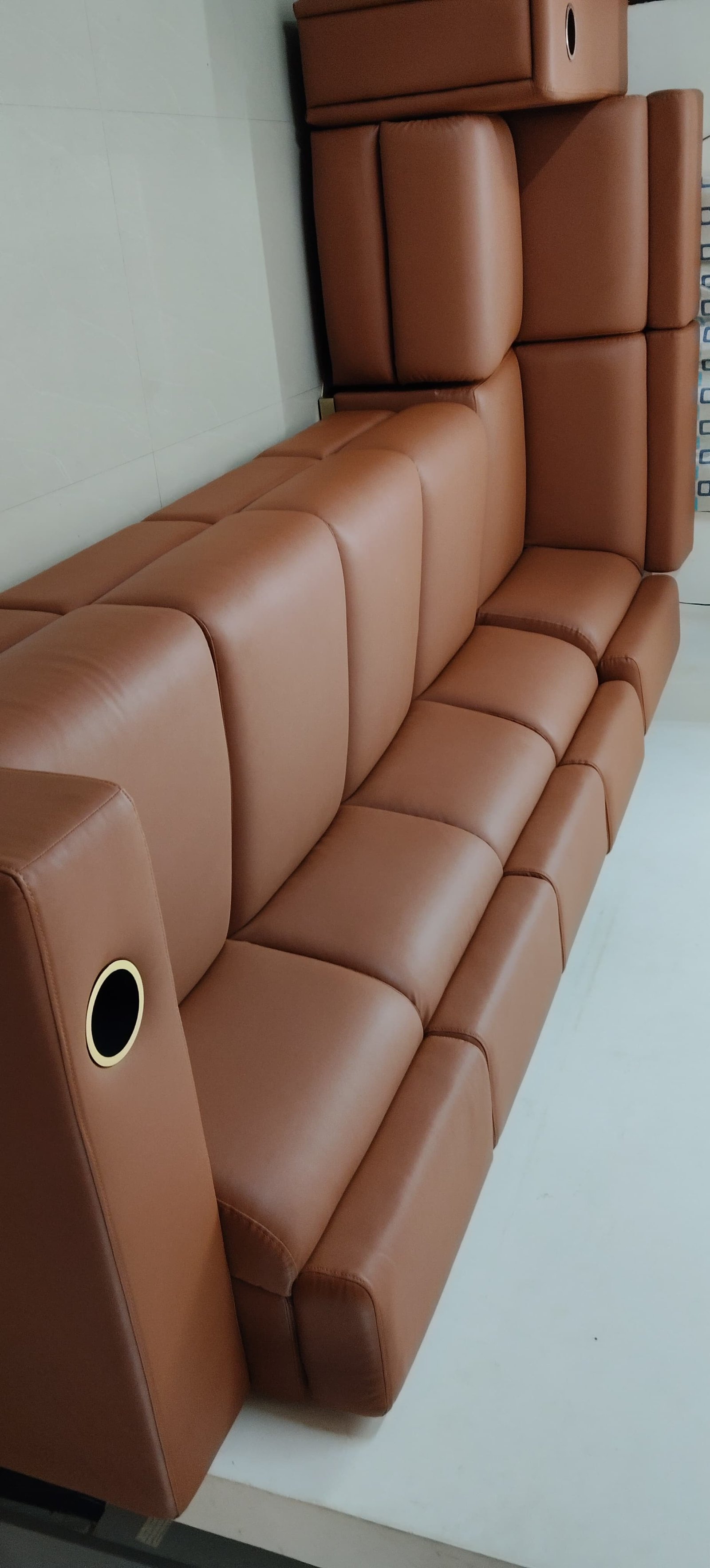
If you want one answer: a solution-dyed polyester or a high-polyester blend weave is the best sofa material for a humid climate like Hyderabad's. It does not absorb moisture the way cotton and linen do, it does not feed mildew, and it holds its colour through a monsoon that runs four months long. Leather is a close second if you are willing to condition it twice a year. Leatherette is the one material we tell customers to walk away from.
We build sofas in Cherlapalli and deliver them across Hyderabad, so we see what this city's weather does to upholstery over five, ten, fifteen years. This is what actually holds up.
What Hyderabad's weather actually does to a sofa
Hyderabad puts a sofa through two different stresses in the same year.
From June to September, relative humidity regularly sits above 70%. Moisture moves into anything absorbent — the cover, the foam, the wood. Natural fibres swell slightly and stay damp longer. That damp is what mildew needs, and mildew is what produces the musty smell people notice when they come back from a two-week trip. Untreated or poorly seasoned frame timber can also swell and then shrink again, and joints that were tight in May start to creak by August.
Then from March to May, the same sofa sits in dry heat. Leather that was never conditioned loses its oils and starts to crack at the fold lines. Polyurethane coatings on faux leather get brittle.
So the material you want is one that ignores both: it should not absorb water, and it should not depend on a surface coating that heat can break down.
The best sofa fabrics for a humid climate, ranked
1. Solution-dyed polyester and poly-blend weaves
This is what we recommend to most Hyderabad customers, and it is what we use most often in our own builds.
Polyester fibres are hydrophobic — they do not draw water in. A spill sits on the surface long enough to be blotted instead of soaking into the padding. Because the fibre stays dry, there is nothing for mildew to colonise. "Solution-dyed" means the colour is added while the fibre itself is being made rather than printed onto finished cloth, so the shade goes all the way through and survives years of indirect sunlight without fading to a patchy version of itself.
The old objection to polyester was that it felt like plastic. That has not been true for a long time. Modern chenille and textured poly weaves are soft, matte, and read as expensive.
2. Cotton-polyester blends
A blend in the range of 60% polyester to 40% cotton gets you most of the moisture resistance with more breathability and a more natural hand-feel. This is a good middle option for families who want the sofa to feel soft rather than technical.
Push the cotton content above half and you start giving up the advantage. Pure cotton is comfortable and washes well, but it absorbs and holds moisture — exactly what you do not want in August.
3. Genuine leather
Real leather performs well here, with one condition: you have to maintain it. Leather does not host mildew the way woven fabric does, it wipes clean in seconds, and a good hide gets better looking with age.
The catch is Hyderabad's dry season. Leather needs its oils replaced or it cracks. Condition it twice a year and keep it out of direct afternoon sun and a leather sofa will outlast almost anything else in the room. Skip that and it will look tired in three years. We go into the full trade-off in our guide to fabric versus leather sofas.
4. Leatherette and faux leather — avoid
This is the one genuine mistake we see repeatedly. Leatherette is a fabric backing with a polyurethane coating on top. Heat and humidity attack the bond between those two layers. The coating goes brittle, then it cracks, then it flakes off in sheets and the sofa cannot be repaired — only recovered.
It is cheap for a reason. In this climate it is the shortest-lived surface you can put on a sofa.
5. Linen and velvet — beautiful, with caveats
Linen is a genuinely lovely fabric and it breathes better than almost anything. It is also highly absorbent, wrinkles readily, and in a humid room it will hold damp. If you love linen, it works best in an air-conditioned living room that gets used every day, not a formal room that stays shut.
Velvet is the opposite problem. It handles humidity better than people expect, but a cotton-pile velvet will crush and mark. A polyester-pile velvet gives you the same depth of colour without the sensitivity — that is the version to specify.
Quick comparison
| Material | Humidity resistance | Maintenance | Best for |
|---|---|---|---|
| Solution-dyed polyester | Excellent | Low | Most Hyderabad homes, families, pets |
| Cotton-poly blend (60/40) | Good | Low | Softer feel, everyday use |
| Genuine leather | Very good | Condition twice a year | Long-term buy, easy wipe-clean |
| Polyester velvet | Good | Vacuum regularly | Formal rooms, deep colour |
| Linen / pure cotton | Poor | High | Air-conditioned rooms only |
| Leatherette / faux leather | Poor | Fails outright | Not recommended here |
The cover is not usually what fails
Most people choose a sofa by touching the fabric. In a humid climate, what sits underneath the fabric decides whether the sofa is still good in year eight.
The frame
Timber that was not properly seasoned before it was cut will keep moving as the seasons change. It swells in the monsoon, shrinks in the summer, and the joints loosen — that is where creaking comes from. Well-seasoned hardwood, joined properly rather than stapled, stays quiet. This is invisible at the point of sale, which is exactly why it is the first thing cut from a cheap sofa.
The foam
Low-density foam holds moisture longer and collapses faster, and once it has been damp a few times it never fully recovers its shape. Higher-density foam in the seat is the single upgrade that most changes how a sofa feels in year five. You can read how we specify both in our materials and specifications page.
Under the cushions
Elastic webbing degrades faster in heat and humidity than serpentine springs do. If a sofa is going to sit in a room without air conditioning, springs are the more durable choice.
Why we can tell you this
We are a manufacturer, not a retailer. Every sofa we sell is built at our own factory in Cherlapalli, which means we choose the timber, cut the foam, and stitch the cover ourselves — and we hear about it directly if something fails four monsoons later.
It also means you can specify the material rather than pick from whatever a showroom has in stock. Fabric, foam density, frame, dimensions and configuration are all decisions you get to make. Custom sofas start around ₹45,000, and buying direct typically saves about ₹20,000 against a comparable showroom sofa, because there is no middleman markup in between.
You are also welcome to come and look before you commit. Our workshop is open Monday to Saturday, 9:30 to 19:30 — see how we build, or plan a factory visit.
Keeping any sofa healthy through the monsoon
- Move it off the wall. Ten centimetres of gap lets air circulate behind the sofa instead of trapping damp against the back panel.
- Vacuum the crevices monthly. Dust holds moisture; removing the dust removes the problem.
- Blot spills, never rub. Rubbing drives liquid down into the foam, which is the part that stays wet.
- Run a fan in a closed room. If a room stays shut for days, moving air matters more than any fabric treatment.
- Keep it out of direct sun. Afternoon sun through an uncovered window fades fabric and dries leather.
Our full routine is in the sofa care and maintenance guide.
Frequently Asked Questions
Which sofa fabric is best for Hyderabad weather?
A solution-dyed polyester or a high-polyester blend. It does not absorb moisture, so mildew has nothing to grow on, and the colour holds through years of monsoon and summer sun.
Does a leather sofa get damaged in humidity?
Not by humidity itself — genuine leather handles damp well and wipes clean. What damages it is the dry season that follows. Condition it twice a year and it will be fine.
Why does my sofa smell musty during the monsoon?
Moisture has reached the foam, usually through an absorbent cover, and mildew has started in it. Pull the sofa away from the wall, vacuum it, dry the room with a fan, and consider a moisture-resistant cover the next time you recover it.
Is leatherette a bad choice in Hyderabad?
Yes. The polyurethane coating separates from its backing in heat and humidity, and once it starts flaking there is no repair — only recovering the whole sofa.
Can I choose my own fabric on a custom sofa?
Yes. Because we manufacture, you choose the fabric, the foam density and the dimensions. Bring your room measurements and we will quote against them — see custom furniture or browse our sofa range.