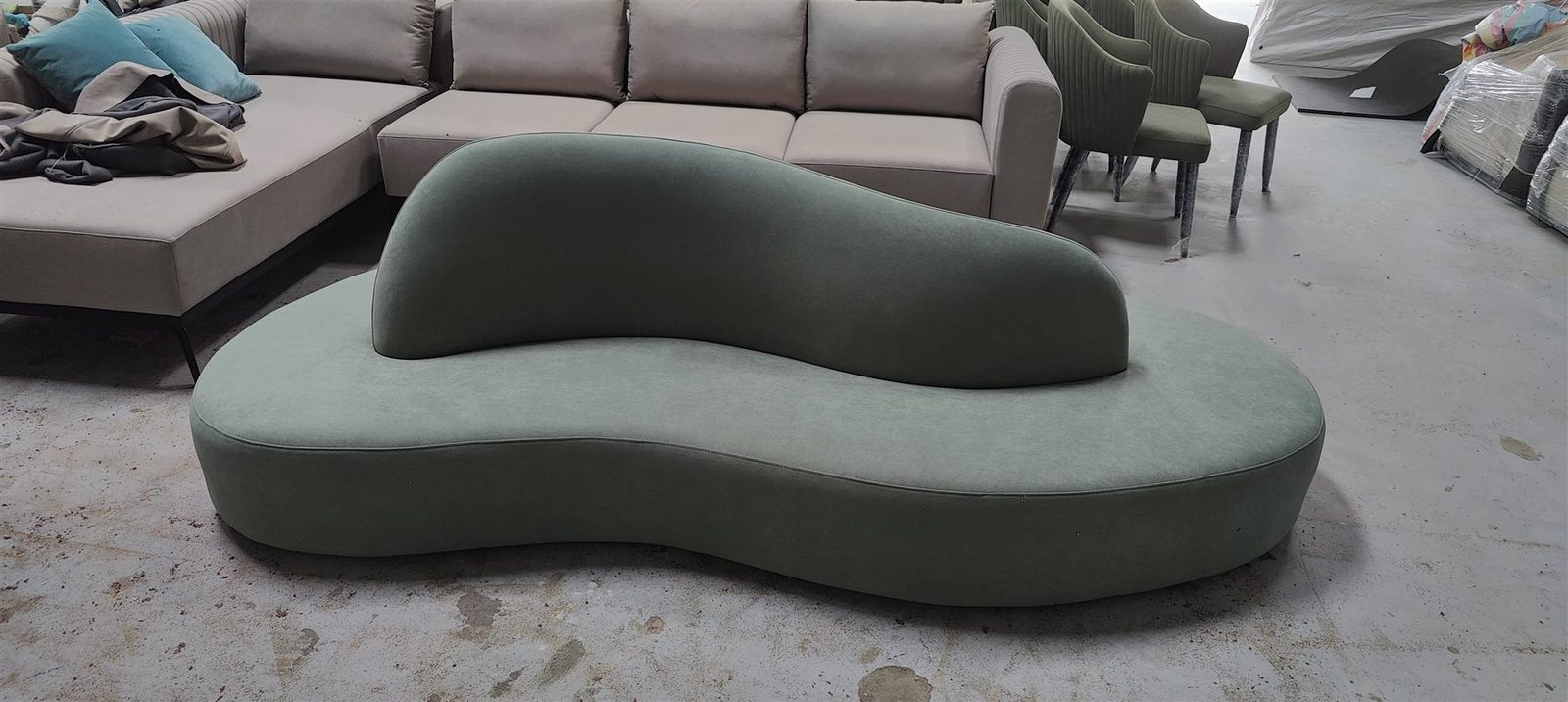
A curved sofa buys you two things a straight one cannot: a room with no hard corners in it, and seating where people actually face each other. It costs you floor space, flexibility and money. Whether that trade is worth making comes down to the shape you choose and the room you put it in.
We build these at our factory in Cherlapalli — the sage-green piece above is one of ours, photographed on the workshop floor before it went out. Here is what the different shapes actually do, and where each one disappoints people.
The six shapes
1. Serpentine (S-curve)
One continuous wave — the back curves out, then in, then out again. The classic sculptural sofa, and the hardest to build well because the frame changes direction twice.
It works beautifully floating in the middle of an open-plan room, where it can be seen from all sides. Push it against a wall and you have paid for a shape nobody can see.
2. Kidney or bean
A single soft arc with a rounded, often armless back that tapers at both ends. Lower and lighter-looking than a serpentine, which makes it the easier one to live with in a normal-sized room. The piece in the photograph above is this type.
Because the back tapers away, it does not block sightlines — useful in a flat where the living room runs into the dining area.
3. Crescent (half-moon, C-curve)
A symmetrical arc with arms at both ends, wrapping inward. This is the most conversational shape: everyone seated is angled slightly towards everyone else, which is the entire point of it.
It wants a round or square room, or a bay window. In a long narrow room it looks stranded.
4. Curved sectional
The practical one. Multiple modules with curved faces that join into a sweeping L or U. You get the visual softness of a curve with something much closer to the seat count and wall-hugging behaviour of a normal L-shaped sofa.
If you like the look of curves but have a real family to seat, this is usually the honest answer.
5. Circular or conversation
A full or near-full circle, sometimes with a centre table. Dramatic, and almost never right for an Indian apartment — it needs to be approached from all sides, which means a very large room and no wall contact at all. Hotel lobbies and villa foyers, mostly.
6. Curved chaise
A single-ended lounger with a curved back — part sofa, part daybed. Seats two comfortably, three at a push. Good in a bedroom, a bay window, or as a second piece opposite a main sofa.
Shapes at a glance
| Shape | Seats | Against a wall? | Best room |
|---|---|---|---|
| Serpentine | 3-4 | Wastes the shape | Open-plan, floating |
| Kidney / bean | 2-3 | Partially | Normal living rooms |
| Crescent | 3-5 | No | Square or round rooms, bay windows |
| Curved sectional | 4-6 | Yes | Family living rooms |
| Circular | 5-8 | No | Very large spaces only |
| Curved chaise | 2 | Partially | Bedrooms, corners, second seating |
The pros
- It softens a hard room. Indian flats are boxes — square rooms, straight walls, rectangular everything. One curve changes the whole feel of a space more than any amount of styling.
- People can actually talk. On a straight sofa everyone faces the TV and nobody faces each other. On a crescent or kidney, the geometry turns you slightly inward.
- It divides open-plan space without a wall. The back of a curved sofa is a soft boundary between living and dining. Better than a partition and it costs you nothing in light.
- No corners. A genuine advantage with a toddler in the house, and the reason these turn up in paediatric waiting rooms.
- It fits awkward geometry. Bay windows, rounded balconies, angled walls — a curve follows them where a rectangle fights them.
- It is a statement. One curved piece does the work of a room full of decoration.
The cons — read these before you commit
- It wastes floor space. This is the big one. A curved back cannot sit flush against a straight wall, so you lose a crescent-shaped strip of dead floor behind it. In a 10 x 12 ft living room that is space you do not have.
- Fewer seats per foot. A curve takes more wall length to seat the same number of people than a straight sofa does. If seat count is the priority, a curve is the wrong tool.
- It costs more to build. Curved frames, hand-shaped foam and panelled upholstery all take longer and waste more material. Expect to pay meaningfully more than for a straight sofa of the same size and quality.
- Your rug and coffee table will not fit. Standard rectangular rugs and tables look wrong against a curve. Budget for a round or oval table, and a rug large enough that the curve sits on it rather than beside it.
- Patterned fabric distorts. Stripes, checks and large repeats bend and break across a curved surface. Plain fabrics, small textures and velvets are the safe choices. Fabric behaviour in this climate matters too — see our guide to materials for Hyderabad's humid weather.
- You cannot rearrange it. A straight sofa works on three walls. A curve usually works in exactly one position, and you are committed to it.
- Reupholstering later is harder. Curved panels have to be re-cut and re-fitted, not simply re-covered. Fewer workshops will take the job on, and it costs more when they do.
- Getting it in is a real problem. A curved frame has a wide fixed footprint and cannot be turned diagonally through a doorway the way a rectangle can. Measure the lift, the stairwell turn and the door before you order, not after.
Why curved sofas cost what they cost
Worth understanding, because it is also how you tell a good one from a bad one.
The frame
A straight sofa frame is cut and jointed timber. A curve has to be built up — either laminated in layers and bent, or cut in segments and joined. Cheap curved sofas skip this and use MDF or particle board shaped on a machine, because it is fast. It also has no structural memory: it sags at the curve and cannot be repaired.
Ask what the curve is made from. If the answer is vague, assume board.
The foam
Foam for a curve is cut oversize and then shaped down by hand to follow the frame. That is skilled, slow work and it wastes a lot of material. Rushed shaping shows up as a lumpy, uneven back within a year.
The upholstery
This is the visible tell. A curved surface cannot be covered in one flat piece — it needs multiple panels cut on the correct grain and stitched to follow the shape. Done well you barely notice the seams. Done badly you get puckering along the curve, and it gets worse as the fabric relaxes.
When you look at a curved sofa, run your eye along the outside back. Ripples mean the panels were fought into place.
Making one fit an Indian flat
Three practical rules from building these:
- Float it, or do not buy it. If the only place it can go is flat against a wall, buy a curved sectional instead and keep the money.
- Leave 45 cm behind it. The gap behind a floating curve is not wasted if you can walk through it. Under that it just reads as a mistake.
- Get the size made to the room. Standard curved sofas are designed for larger Western rooms. This is the whole advantage of a manufacturer — we set the radius and the length to your floor plan rather than the other way round. See custom furniture and how we build.
You are welcome to see one being built. The workshop is open Monday to Saturday, 9:30 to 19:30 — plan a visit, or browse the sofa range.
Frequently Asked Questions
Are curved sofas comfortable?
Yes, and often more so than straight sofas, because the back follows your spine rather than meeting it at a right angle. Comfort depends on foam density and seat depth, not on the curve.
Do curved sofas work in small rooms?
Rarely as a main sofa — they cannot sit flush to a wall, so they cost floor space a small room does not have. A curved chaise or a curved sectional is the better choice under about 12 ft of wall.
Which curved sofa shape seats the most people?
A curved sectional or a circular sofa. Serpentine and kidney shapes are statement pieces and typically seat two to four.
What fabric is best on a curved sofa?
Plain fabrics, small textures and velvets. Stripes, checks and large prints distort across the curve. In Hyderabad's climate, a polyester or poly-blend weave also handles the monsoon better than cotton or linen.
Are curved sofas more expensive than straight ones?
Yes. The frame has to be laminated or segmented, the foam hand-shaped, and the upholstery cut in multiple panels — all slower and more wasteful of material than building straight.
Can you make a curved sofa to my room size?
Yes. Because we manufacture, the radius, length, seat depth and fabric are all specified to your room. Send us the floor plan or the room dimensions.