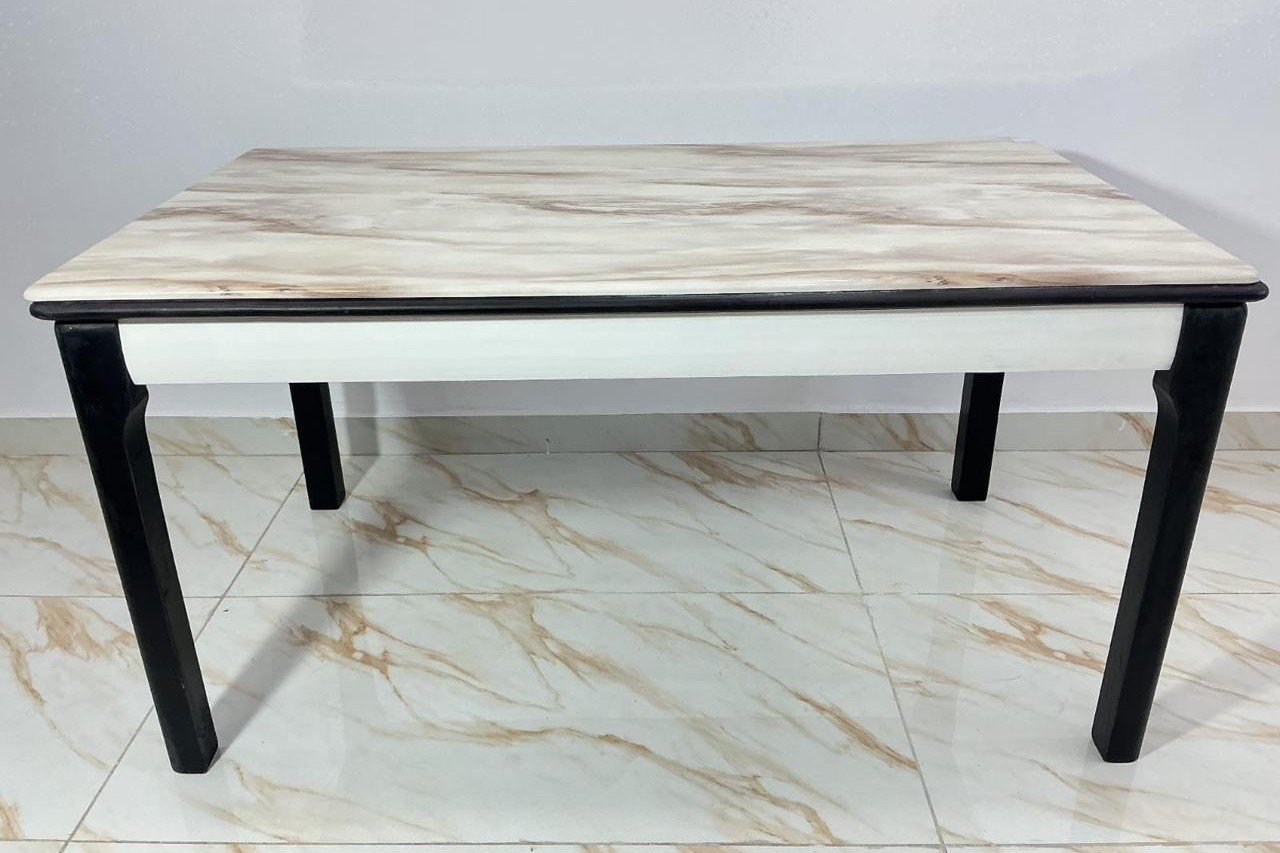
The table is almost never the problem. The space around it is. A 6-seater dining table is about 6 ft long — but it needs a room roughly 12 ft long to actually use, because a chair has to pull out and somebody has to walk behind it.
That gap between "the table fits" and "the table works" is where most dining room regret comes from. We build these in Cherlapalli, so here are the real numbers.
Standard dining table sizes in India
As with beds, there is no Indian standard — but these are the sizes actually sold:
| Seats | Typical top size | In centimetres | Shape |
|---|---|---|---|
| 2 | 30 x 30 in | 76 x 76 cm | Square or round |
| 4 | 48 x 30 in | 122 x 76 cm | Rectangular or 36 in round |
| 6 | 60-72 x 36 in | 152-183 x 91 cm | Rectangular or 54 in round |
| 8 | 78-96 x 40 in | 198-244 x 102 cm | Rectangular or oval |
| 10 | 108 x 44 in | 274 x 112 cm | Rectangular |
Two things drive those numbers, and both are worth knowing because they let you check any table you are shown.
60 cm per person
Each diner needs about 60 cm (24 in) of table edge for a plate, a glass and their elbows. So a six-seater with three down each long side needs at least 180 cm (72 in) of length. That is why a "6 seater" that measures 150 cm is really a tight five.
90 cm of width
The table also needs to be about 90 cm (36 in) wide so that two people opposite each other are not sharing knee space, with room for serving dishes down the middle. Below 80 cm it starts to feel like a corridor.
The number everyone forgets: clearance
This is the measurement that decides whether the room works.
You need 90 cm (36 in) between the table edge and the nearest wall or furniture — 75 cm absolute minimum, 105 cm if people need to walk behind seated diners. Roughly 60 cm of that is the chair pulling out, and the rest is a person getting past.
So the arithmetic is:
Table length + 180 cm = minimum room length. Same for width.
| Room size | Table that actually works |
|---|---|
| 8 x 8 ft | 4 seater, or a 36 in round |
| 10 x 8 ft | 4 seater comfortably, 6 at a squeeze |
| 10 x 10 ft | 6 seater, or a 48-54 in round |
| 12 x 10 ft | 6 seater comfortably |
| 14 x 11 ft and up | 8 seater |
One Hyderabad-specific note: in most flats the dining area is not a separate room, it is a zone in an open-plan living space. Measure to the real obstacles — the sofa back, the kitchen counter, the passage to the balcony — not to the walls.
Rectangular, round, oval or square?
| Shape | Best for | Trade-off |
|---|---|---|
| Rectangular | Long rooms; most seats per square foot | Corner seats are the worst seats |
| Round | Square rooms, conversation, no sharp corners | Wastes space in a long room; hard to extend |
| Oval | A round table's feel with a rectangle's efficiency | Costs more to make |
| Square | Small square rooms, 4 people | Does not scale past 4 without becoming huge |
A round table seats people more sociably — nobody is at a corner, and everyone can see everyone. A 54 in (137 cm) round comfortably seats six; a 48 in seats four, or six at a push if the base is a single pedestal rather than four legs.
That last detail matters more than people expect. A pedestal or trestle base lets you slide an extra chair in anywhere. Four corner legs fix your seating positions permanently. If you ever host more than your usual number, choose the base accordingly.
Height: the mismatch nobody checks
Dining tables are about 75 cm (30 in) high. Dining chair seats are about 45 cm (18 in). That leaves roughly 30 cm of thigh clearance, which is what comfortable eating needs.
Where it goes wrong is the apron — the frame rail under the top. A deep apron eats into that 30 cm, and if it drops more than about 10 cm you will feel it against your thighs, particularly with chairs that have arms.
Two checks before you buy:
- Measure floor to the underside of the apron, not floor to the top. That is the number your legs live with.
- Take your chair measurements with you if you already own chairs. Armchairs need the arms to slide under the apron, or they sit awkwardly far back. See our chairs range for how arm heights vary.
Tops: what a manufacturer would tell you
| Top | Holds up to | Watch out for |
|---|---|---|
| Solid hardwood | Decades; can be sanded and refinished | Moves with humidity if not properly seasoned |
| Marble / stone | Heat, knives, daily use | Very heavy — needs a base built for it; stains if unsealed |
| Engineered wood + veneer | Light use | Edges chip and cannot be repaired |
| Glass | Wiping clean | Shows every fingerprint; edges chip |
On solid wood in this climate: timber that was not properly seasoned keeps moving as the humidity swings between the monsoon and the dry season, and a wide tabletop is where that shows first — as a cupped surface or an opening joint. The same principle we cover for upholstery in our guide to materials for Hyderabad's humid weather applies to a dining top, only more visibly.
On marble: the weight is the thing people underestimate. A stone top needs a base engineered for it, and it is not a piece you will be shifting around the room on a whim. Ask what the base is made from, not just the top. Our materials and specifications page sets out how we build both.
Are extendable tables worth it?
They can be, with the same caveat as any convertible furniture: the mechanism is the part that fails.
A drop-in leaf — where you pull the halves apart and set a loose panel in the gap — has almost nothing to go wrong, but you have to store the leaf somewhere. A butterfly leaf folds inside the table, which is far more convenient and considerably more to go wrong.
If you extend twice a year, buy the simple one. If you genuinely change the table size most weeks, pay for a good mechanism and ask whether it can be repaired.
Getting one made to the room
Standard sizes are built for standard rooms. If your dining zone is 11 ft long, a 6 ft table leaves you 2.5 ft at each end — usable, but tight. A 5 ft 6 in table would give you a proper walkway, and no retailer stocks that size.
Because we manufacture, the length, width, height, base type and top are all yours to specify. Send the room dimensions — including where the sofa and the kitchen counter sit — and we will work back from the clearance rather than forward from a catalogue size.
See the dining table range, custom options, or how we build. The workshop is open Monday to Saturday, 9:30 to 19:30 — plan a visit.
Frequently Asked Questions
What is the standard size of a 6 seater dining table?
Typically 60 to 72 inches long by 36 inches wide (152-183 x 91 cm). The length matters most: at 60 cm of edge per person, three people down each side need at least 180 cm to sit comfortably.
What size room do I need for a 6 seater dining table?
About 12 x 10 ft to use it comfortably. Add 90 cm of clearance on every side you need to walk or pull a chair out — so table length plus 180 cm is your minimum room length.
What is the standard size of a 4 seater dining table?
Around 48 x 30 inches (122 x 76 cm) rectangular, or a 36 inch round. A 4-seater fits an 8 x 8 ft space with reasonable clearance.
How much space do you need per person at a dining table?
60 cm (24 in) of table edge each. Below that, elbows collide and place settings overlap.
Is a round or rectangular dining table better?
Round is more sociable and suits square rooms, but wastes space in a long room and is hard to extend. Rectangular gives the most seats per square foot. In most Indian flats the dining zone is longer than it is wide, which favours rectangular.
What is the standard dining table height?
About 75 cm (30 in), paired with a 45 cm (18 in) chair seat. Check the height to the underside of the apron rather than to the tabletop — that is what your legs actually have.
Can I get a dining table made to my room size?
Yes. Send the room dimensions and where the surrounding furniture sits, and we will build to the clearance your space allows.