A damp rubber glove will pull more hair off a sofa in two minutes than a vacuum will in ten. Rubber generates static and grabs hair; suction mostly pulls it deeper into the weave. That one swap solves most of the problem.
The rest of this is the order to do things in, what to avoid, and — the part nobody tells you — why hair clings ferociously to some sofas and brushes straight off others. We build sofas in Cherlapalli, so we see both kinds come back.
What actually works, in order
| Method | Cost | Best for | Catch |
|---|---|---|---|
| Damp rubber glove | Free | Everything — start here | Rinse it often or you just move hair around |
| Window squeegee | Cheap | Large flat seat and back panels | Awkward in crevices |
| Vacuum + upholstery brush | Owned | Second pass, crevices, under cushions | Alone it drives hair deeper |
| Lint roller | Low, recurring | Finishing touches before guests | Wasteful for a whole sofa |
| Rubber broom | Cheap | Big sectionals, floor as well | Too coarse for delicate weaves |
| Fabric softener mist | Very low | Loosening static-bound hair | Mist, never soak — see below |
The sequence that works
- Dry pass first. Rubber glove or squeegee, short strokes, always in one direction. Hair gathers into rolls you can lift off by hand.
- Light mist if it is clinging. One part fabric softener to about thirty parts water in a spray bottle, misted — not sprayed wet. It breaks the static bond. Let it flash off before the next step.
- Second rubber pass. This is where the stubborn hair comes up.
- Vacuum last, with the upholstery brush, including the crevices and under the cushions. By now you are collecting loose hair rather than pushing it in.
- Lint roller only for whatever is left on the visible panels.
Vacuuming first is the common mistake. Suction without agitation pushes fine hair further into the weave, and then no amount of rubber gets it back out.
What not to do
- Do not soak the fabric. Upholstery foam holds water for days, and in Hyderabad's humidity that is how a sofa starts smelling musty. A light mist evaporates; a wet patch does not. We go into this in our guide to sofa materials for Hyderabad's humid weather.
- Do not use a stiff brush on velvet or any looped weave. It pulls the pile and leaves a permanent bald patch that looks worse than the hair did.
- Do not use sticky tape on leather. It lifts the finish. On leather a plain damp microfibre cloth is all you need — hair never embeds in the first place.
- Do not use a pet grooming rake on upholstery. The teeth are designed to reach through a coat to skin. On fabric they snag the weave.
Why hair sticks to some sofas and not others
This is the real answer to the problem, and it is decided before you ever buy the sofa.
Hair clings for two reasons: static, and somewhere to lodge. A weave with loops, slubs or a long pile gives every hair a place to hook into. A tight, flat, smooth weave gives it nothing to hold, so hair sits on the surface and wipes away.
| Fabric | Hair behaviour | Claws | Verdict for pets |
|---|---|---|---|
| Tight flat weave (microfibre, canvas) | Sits on top, wipes off | Resists snagging | Best overall |
| Polyester velvet | Brushes off along the pile | Good — no loops to catch | Very good, brush one way |
| Bouclé and looped weaves | Lodges in the loops | Claws pull threads out | Avoid with pets |
| Linen and loose-weave cotton | Works into the weave | Snags readily | Avoid |
| Genuine leather | Does not embed at all | Scratches show permanently | Easiest to clean, marks easily |
| Leatherette | Does not embed | Punctures and peels | Avoid |
Two practical notes. Colour matters more than people expect — a mid-tone fabric close to your pet's coat hides what remains, while a dark sofa and a white dog is a daily chore you have signed up for. And a high-twist, tightly-woven synthetic beats a natural fibre every time here, because the fibre is smooth and the weave has no gaps.
When specifying upholstery for a home with pets, ask to see tight flat weaves and polyester velvets rather than anything with a loop or a slub. Furnishing houses such as Sarom carry upholstery ranges that include these constructions, and any good supplier will tell you the composition and weave if you ask — if they cannot, that is informative in itself.
Make the next sofa easier to live with
If you have pets and you are buying rather than cleaning, three decisions do most of the work:
- Specify the weave, not just the colour. This is the single biggest factor, and it costs nothing to get right at the order stage.
- Ask for removable, washable covers. A cover that unzips is worth more than any cleaning technique. Our sofa cover sizing guide explains how to get one that actually fits.
- Get the foam density right. Pets lie in the same spot every day. Low-density foam takes a permanent dent — see our materials and specifications.
Because we manufacture rather than resell, the fabric, weave, foam density and dimensions are all yours to choose — the same workshop in Cherlapalli also produces our Mavensoft range. Tell us there is a dog in the house and we will steer you away from the fabrics that will not survive it.
Browse the sofa range, see custom options, or visit the workshop — Monday to Saturday, 9:30 to 19:30. Bring a photo of your pet; the coat colour genuinely changes what we would recommend.
Frequently Asked Questions
What is the fastest way to remove pet hair from a couch?
A damp rubber glove, wiped in short strokes in one direction. Rubber attracts hair by static far more effectively than suction, and it takes a couple of minutes.
Does a vacuum remove pet hair from upholstery?
Partly, and it works best as a second step. Vacuuming first tends to push fine hair deeper into the weave. Lift the bulk with rubber, then vacuum.
Does fabric softener spray help?
Yes, heavily diluted and misted, because it breaks the static bond holding hair to the fibres. Never soak the fabric — the foam underneath holds moisture and will smell.
Which sofa fabric is best if you have pets?
A tight flat weave such as microfibre, or a polyester velvet. Both are smooth enough that hair sits on the surface and dense enough that claws do not snag. Avoid bouclé, loose linen and leatherette.
Is leather good for pets?
Hair never embeds and it wipes clean in seconds, which is a genuine advantage. The trade-off is that claw scratches are permanent and visible. Fabric hides wear better; leather cleans better.
How often should I do this?
A rubber-glove pass once a week takes five minutes and prevents hair working into the weave. Once it is embedded, it is far more work to get out.
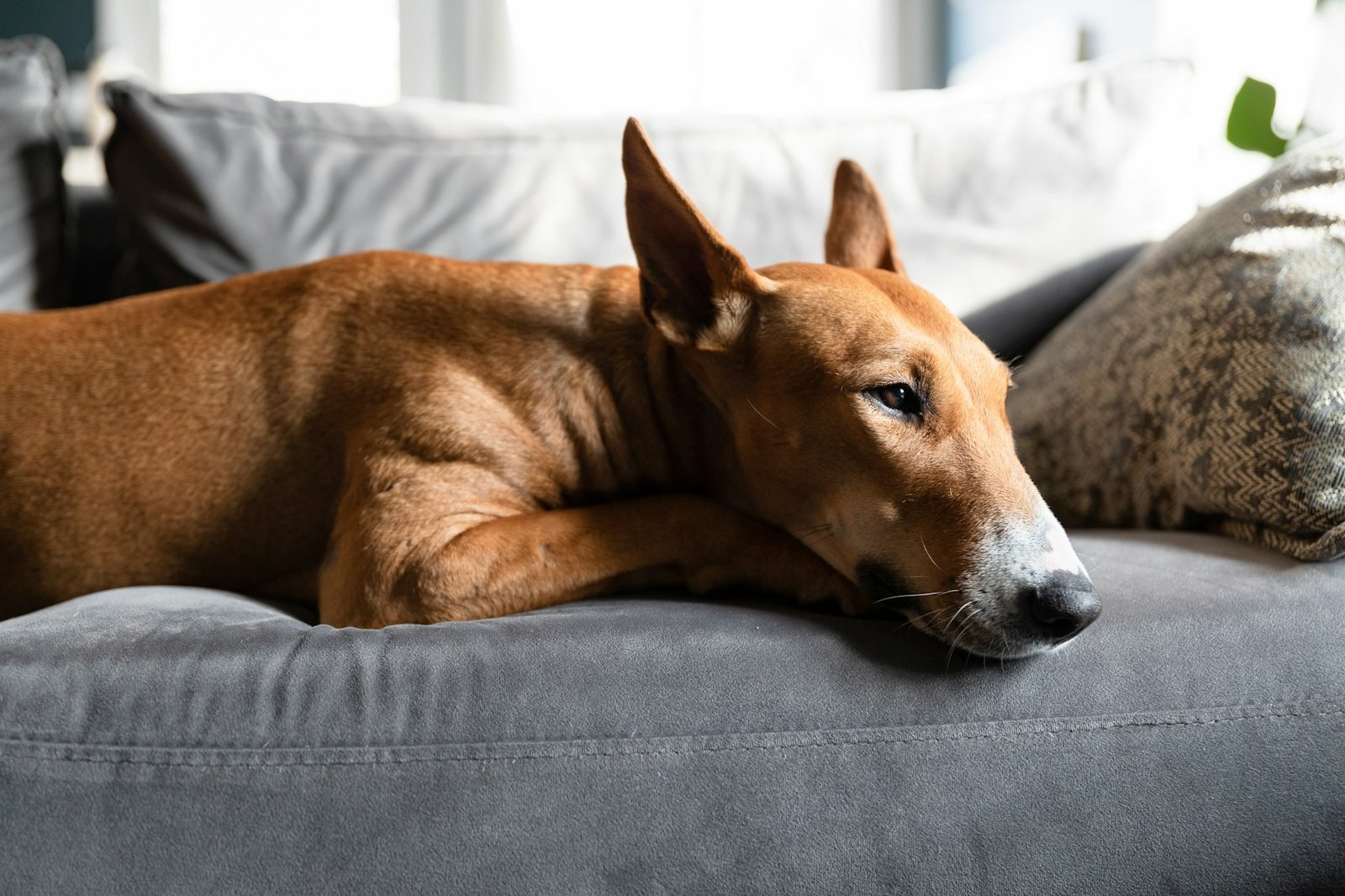
Header photograph by Felicia Montenegro on Unsplash.