Stop searching for a "3 seater sofa cover". Measure your sofa first. Seat count is not a dimension — two sofas both sold as three-seaters can be 30 cm apart in width, and that is exactly why so many covers arrive too loose at one end and too tight at the other.
We build sofas in Cherlapalli, so we know how much the dimensions vary between makers. Here is how to measure yours, which cover type suits which sofa, and when a cover is the wrong answer entirely.
Why "3 seater" tells you almost nothing
There is no Indian standard for sofa width. "Three-seater" means the maker thinks three people can sit on it. That is a judgement, not a measurement.
In practice, sofas sold under the same label land anywhere in these ranges:
| Sold as | Typical overall width | In centimetres |
|---|---|---|
| 1 seater / armchair | 30-40 in | 76-102 cm |
| 2 seater | 48-60 in | 122-152 cm |
| 3 seater | 72-84 in | 183-213 cm |
| L-shape, long side | 84-110 in | 213-280 cm |
These are typical ranges we see, not a standard — there isn't one. A 72-inch three-seater and an 84-inch three-seater are both honestly described, and a cover cut for one will not fit the other.
The five measurements to take
Use a fabric tape. Write the numbers down in inches and centimetres both, because sellers mix the two freely.
- Overall width. Outside of the left arm to outside of the right arm, at the widest point. This is the number that decides whether a cover fits at all.
- Seat width. Inside of one arm to inside of the other. Needed for seat-only and cushion covers.
- Overall depth. Front edge of the seat to the furthest-back point of the backrest.
- Overall height. Floor to the top of the backrest.
- Arm height and arm width. Floor to top of arm, and how thick the arm is front-to-back. Thick square arms and thin sloped arms need very different covers.
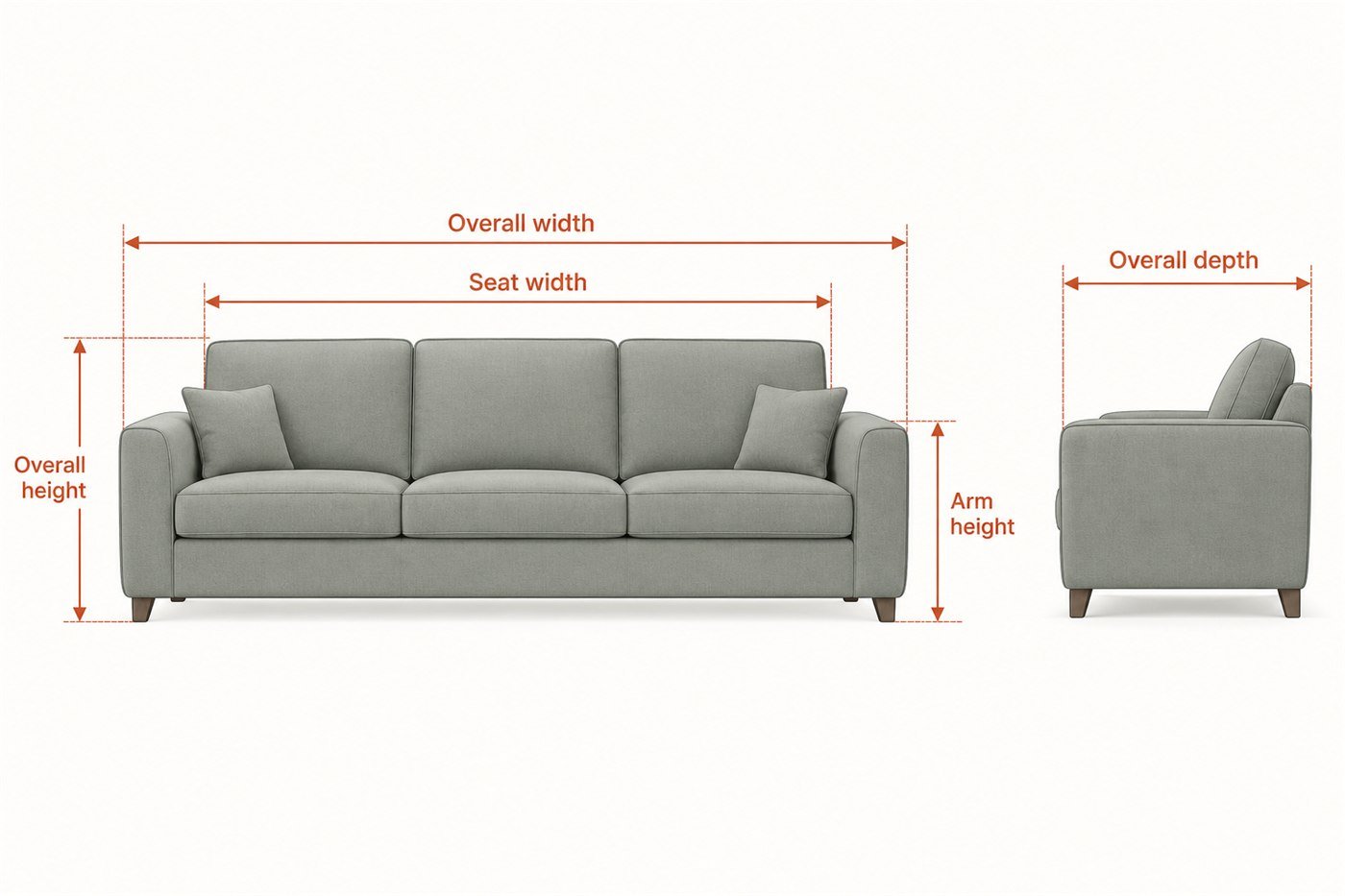
The five measurements, on a standard three-seater. Overall width is the one that decides whether a cover fits at all.
Also count your seat cushions and note whether they lift out. A sofa with three loose cushions needs a different cover from one with a single fixed bench seat, even at identical width.
Which cover type you actually want
| Type | How it fits | Good for | Watch out for |
|---|---|---|---|
| Stretch one-piece | Elastic, pulls over everything | Simple square sofas, quick refresh | Sags within months; needs re-tucking constantly |
| Stretch per-section | Separate pieces per seat and arm | L-shapes, 3+2 sets | Must match section count exactly |
| Tailored / made to measure | Cut to your measurements | Anything unusual, long-term use | Costs more; needs accurate numbers |
| Loose throw | Draped, not fitted | Hiding damage cheaply, pets | Slides off; never looks tidy |
| Cushion covers only | Individual zipped covers | When only the seats are worn | Colour will not match the frame exactly |
For most people with a plain rectangular sofa, stretch per-section is the sensible middle. For anything shaped, tailored is the only thing that works.
Sofas that covers do not fit
This is the part the listings never mention.
- Recliners. The back and footrest move independently. A one-piece cover binds the mechanism and tears at the hinge. You need recliner-specific covers in separate sections, or nothing.
- L-shapes and sectionals. You need to know which way the chaise faces — left-facing and right-facing are different products. Standing in front of the sofa, if the long part is on your left, it is left-facing. Buy the wrong hand and it will not fit.
- Curved sofas. Stretch fabric bridges a curve rather than following it, so it bubbles along the back. A curved piece needs a tailored cover cut in panels — see our guide to curved sofa types.
- Sofas with exposed wooden arms or legs. Covers are cut for upholstered arms. On a wooden-arm frame they leave gaps that look worse than the wear you were hiding.
- Deep-buttoned or channel-tufted backs. A stretch cover flattens the detail you paid for.
Cover or reupholster? The honest answer
A cover hides a problem. Reupholstery fixes it. Which one you want depends on what is actually wrong.
| What is wrong | What to do |
|---|---|
| Fabric is fine, you want a change of colour | Cover |
| Stains or pet damage on an otherwise sound sofa | Cover |
| Fabric worn through, frame and foam still good | Reupholster |
| Seat sags, foam has collapsed | Reupholster — a cover changes nothing |
| Frame creaks or wobbles | Repair the frame first, or replace |
| Leatherette peeling and flaking | Reupholster — covers slip on smooth surfaces |
The test is simple: sit down. If the sofa is still comfortable and only looks tired, a cover is fine. If it no longer supports you, no cover will help — that is foam and webbing, and it needs opening up. We explain what sits under the fabric on our materials and specifications page.
Cover fabric in Hyderabad's climate
A cover adds a second layer over your upholstery, which means whatever moisture gets in is slower to dry out. Through the monsoon that matters.
Polyester and poly-blend stretch covers are the safe choice — they do not hold moisture and they wash and dry quickly. Cotton covers feel nicer and breathe better, but they hold damp against the sofa underneath, and in a closed-up room that is how a musty smell starts. The full reasoning is in our guide to sofa materials for Hyderabad's humid weather.
Whichever you choose, take the cover off and wash it a few times a year rather than leaving it on permanently.
If you want it to actually fit
Because we manufacture, we know the dimensions of every sofa we have built, and we can cut a tailored cover to those numbers rather than to a size label. We can also tell you honestly when a cover is a waste of money and reupholstery is the better spend.
Send us your five measurements, or the photos if measuring is awkward. Browse the sofa range, see custom options, or visit the workshop — Monday to Saturday, 9:30 to 19:30.
Frequently Asked Questions
How do I know what size sofa cover to buy?
Measure the overall width from the outside of one arm to the outside of the other, then match that number to the cover's stated width range. Ignore the seater label — it is not a measurement.
Will a 3 seater sofa cover fit my 3 seater sofa?
Only if the widths match. Three-seaters run roughly 72 to 84 inches, so a cover cut for the narrow end of that range will not stretch over the wide end without distorting.
What is a 5 seater sofa cover?
Usually a set for a 3+2 arrangement — one three-seater cover and one two-seater cover — rather than a single cover for a five-seat sofa. Check the piece count before ordering.
Do sofa covers work on recliners?
Only recliner-specific ones made in separate sections. A standard one-piece cover restricts the mechanism and tears where the back pivots.
Can I get a cover made to my exact sofa?
Yes. Send the five measurements and we will cut it to those, which is the only way to get a proper fit on an L-shape, a curve or a wooden-arm frame.
Should I cover my sofa or get it reupholstered?
Cover it if it is comfortable and merely looks tired. Reupholster it if the seat sags, the foam has collapsed or the fabric has worn through — a cover hides those but does not fix them.